Runway lights
They are not decoration. They are operational infrastructure that must be treated as a priority load.
Manga episode
Captain SolarJet returns after sunset and discovers the central truth of airport power: the runway does not care how sunny noon was.
Noon was beautiful. The landing is at 9:42 p.m.

Episode opening
The Solar Jet Dream looked perfect in daylight. The panels were gleaming. Captain SolarJet was smiling. The crowd believed the future had arrived with a gold-trimmed helmet.
Then the aircraft came home after dark. Runway lights, taxiway lights, communications, security systems, hangar equipment, chargers, and control rooms still needed power. The sun had already left the meeting.
Night landing math, manga style
The comedy gets serious when the airport has to decide what must stay on first.
They are not decoration. They are operational infrastructure that must be treated as a priority load.
Monitoring, switching, communications, and facility controls need stable power when decisions matter.
Electric air taxis, ground vehicles, tools, and support equipment can create hungry nighttime loads.
Stored energy is what lets daytime solar become useful when the landing happens after dark.

Chief Battery explains
Captain SolarJet treats sunset like an insult. Chief Battery treats it like a schedule. A real airport solar strategy must expect nighttime, clouds, fog, outages, peak pricing, and the ordinary fact that important work does not stop when production drops.
Chief Battery’s answer is practical: identify the loads, size the storage, coordinate the controls, and make sure the people maintaining the airport understand the system.
The episode in panels
The joke lands because the airport has to land, too.
Captain SolarJet approaches the runway after sunset, still confident from the glorious daytime takeoff.
He looks down and realizes every runway light, taxiway marker, and support system needs power now.
“Where is the sunlight?” Captain asks. Runway Ojisan points at the moon and keeps drinking coffee.
Madame Kilowatt appears beside the meter, delighted that the evening load arrived unmanaged.
Chief Battery opens the storage system and shows the glow of stored daytime power.
The lights hold. The system works. Captain finally understands why landing gear matters.

Stored power
Solar production can charge batteries when conditions are favorable. Later, stored energy can help support selected loads, reduce exposure to ugly timing, and provide an operating strategy when the sun is gone.
Batteries are not a decorative add-on. They are equipment that must be sized, protected, monitored, labeled, serviced, and integrated into the airport’s actual operations.
Who understands the night?
Captain gets the poster. The night shift belongs to Chief Battery, Runway Ojisan, and the ground crew.
The engineer who knew the landing would happen after sunset and designed accordingly.
Meet Chief Battery
The airport veteran who never trusted a plan that only worked in daylight.
Meet Runway Ojisan
The peak-rate villain who waits for the evening load to arrive without a battery plan.
Meet Madame Kilowatt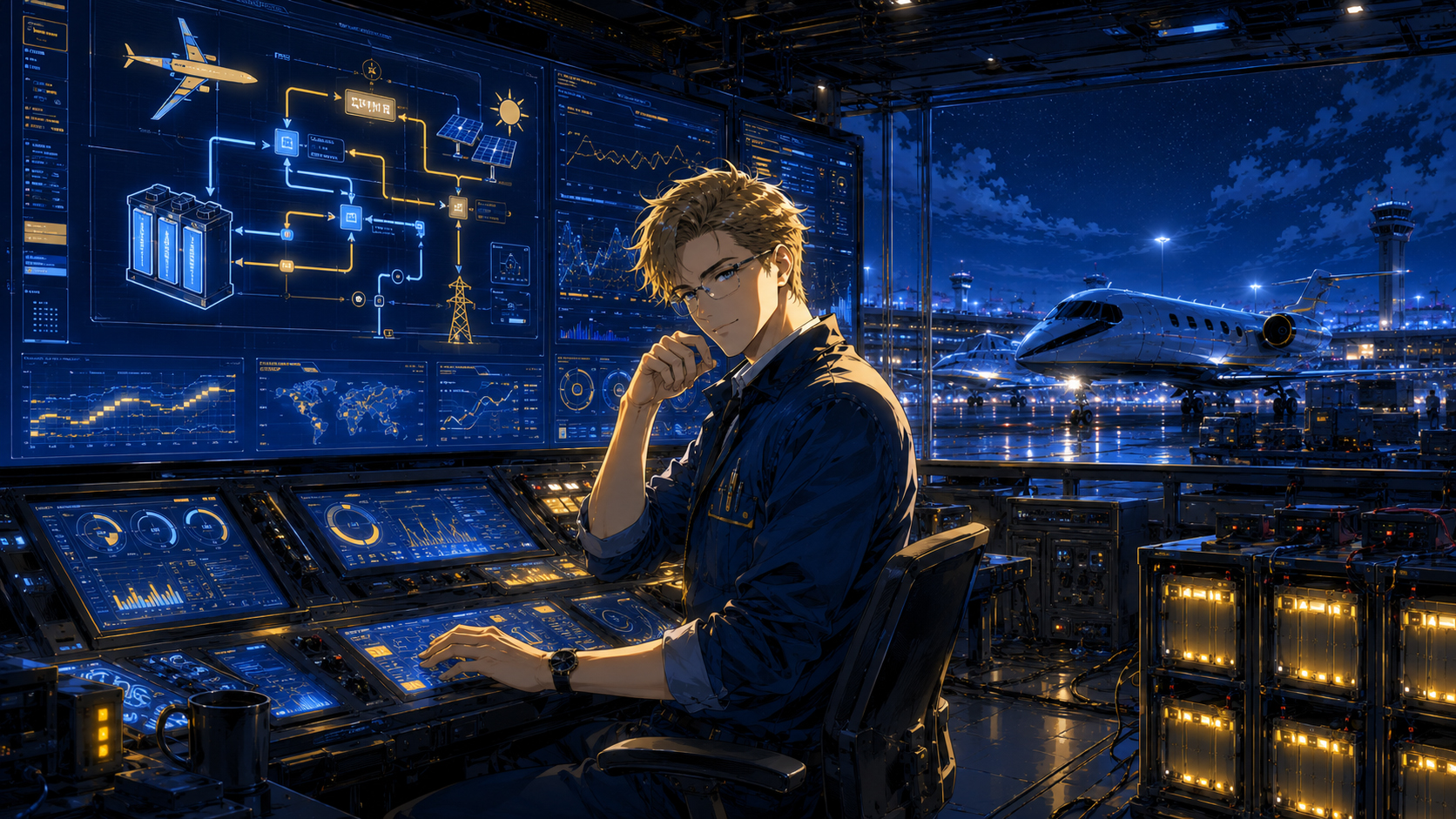
Control room reality
A battery cabinet by itself is not a complete strategy. The airport needs control logic: what charges, what discharges, what remains critical, what can be delayed, when utility power is used, and how the system behaves under stress.
The microgrid control room is where the Night Landing Problem becomes visible. It turns the question “Do we have power?” into a better question: “Are we powering the right things at the right time?”
Related flight paths

The slogan page that turns the joke into the full airport power design brief.
Open page
The practical page about keeping critical airport systems alive when the sun is gone.
Open page
The control-room brain that makes solar, storage, chargers, and critical loads act together.
Open page