Specialty
Battery storage, backup logic, airport microgrids, and preventing heroic nonsense.
Engineer file
The calm engineer who knows solar does not become airport power until storage, controls, load priority, and backup logic are part of the system.
“Captain, the sun is not a night-shift employee.” Chief Battery, five seconds before saving the runway.

Character profile
Chief Battery does not need a cape. He has a single-line diagram, a commissioning checklist, and the patience to explain the same thing every time Captain SolarJet points at the sky.
He is the engineer who turns “solar is amazing” into “solar can actually support a useful load.” In the SolarJets manga universe, he is calm because the batteries are monitored, the priorities are clear, and the joke has a backup circuit.
Official stats
Captain SolarJet brings the drama. Chief Battery brings the operating strategy.
Battery storage, backup logic, airport microgrids, and preventing heroic nonsense.
A load schedule that does not pretend night is optional.
Unplanned peak loads, vague slogans, and anyone who says “just add panels.”
He can lower the room temperature by asking, “What is the critical-load panel?”

The engineering correction
Chief Battery understands the central SolarJets joke: a solar-powered jet is funny because it exposes the difference between generation and reliability. Producing energy is not the same as delivering usable power at the exact moment an airport needs it.
Storage turns sunlight into dispatchable support. Controls decide how power flows. Priority circuits decide what matters first. Monitoring keeps the system honest.
Chief Battery’s checklist
The manga joke lands better when the practical system underneath is clear.
Runway lights, hangar systems, communications, security, chargers, pumps, controls, and service equipment do not all have the same priority.
A battery is not decoration. It must match the loads, duration, discharge limits, equipment ratings, and operating plan.
The microgrid brain decides when to charge, discharge, import, export, shed load, and protect the equipment.

The control room
Solar panels, batteries, chargers, and critical loads are not automatically a strategy. Chief Battery’s real job is making the system behave like one coordinated airport power plant.
The microgrid control room is where the comedy turns into operations: power flow, battery state of charge, charger demand, runway support, and backup modes all need to be visible, intentional, and managed.
Problems Chief Battery solves
Every SolarJets villain is really an energy-design problem in costume.

Intermittent production. Chief Battery answers with storage, controls, and realistic expectations.
Meet Cloudzilla
Peak-hour pain. Chief Battery answers with timing, battery dispatch, and load awareness.
Meet Madame Kilowatt
Paperwork chaos. Chief Battery answers with drawings, documentation, reviews, and patience.
Meet the Permit Goblin
The night test
The easiest solar story happens at noon. Chief Battery is interested in the harder story: the runway at night, the hangar during an outage, the charger during peak demand, and the control system deciding what happens next.
This is why “We land where the sun don’t shine” is more than a punchline. It is the design brief.
Related pages
The serious side of the joke: selected loads, storage duration, and resilient operations.
Open page
The control-room brain that makes solar, storage, chargers, and critical loads act together.
Open page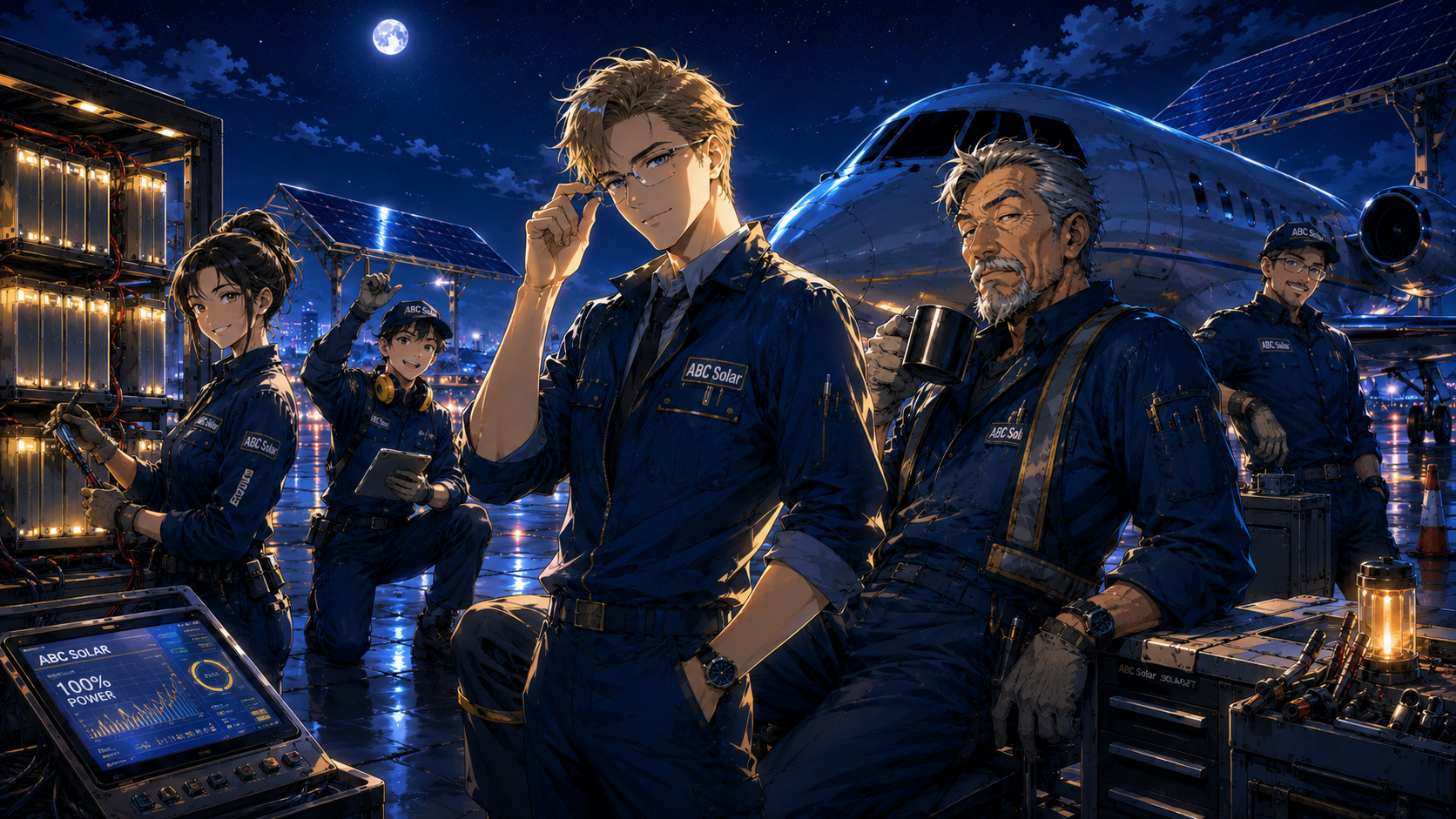
The people who wire the dream, check the details, and keep the joke from tripping a breaker.
Open page