The bill
The monthly electric bill is not solved by pretending a Jet Ski purchase is a savings program.
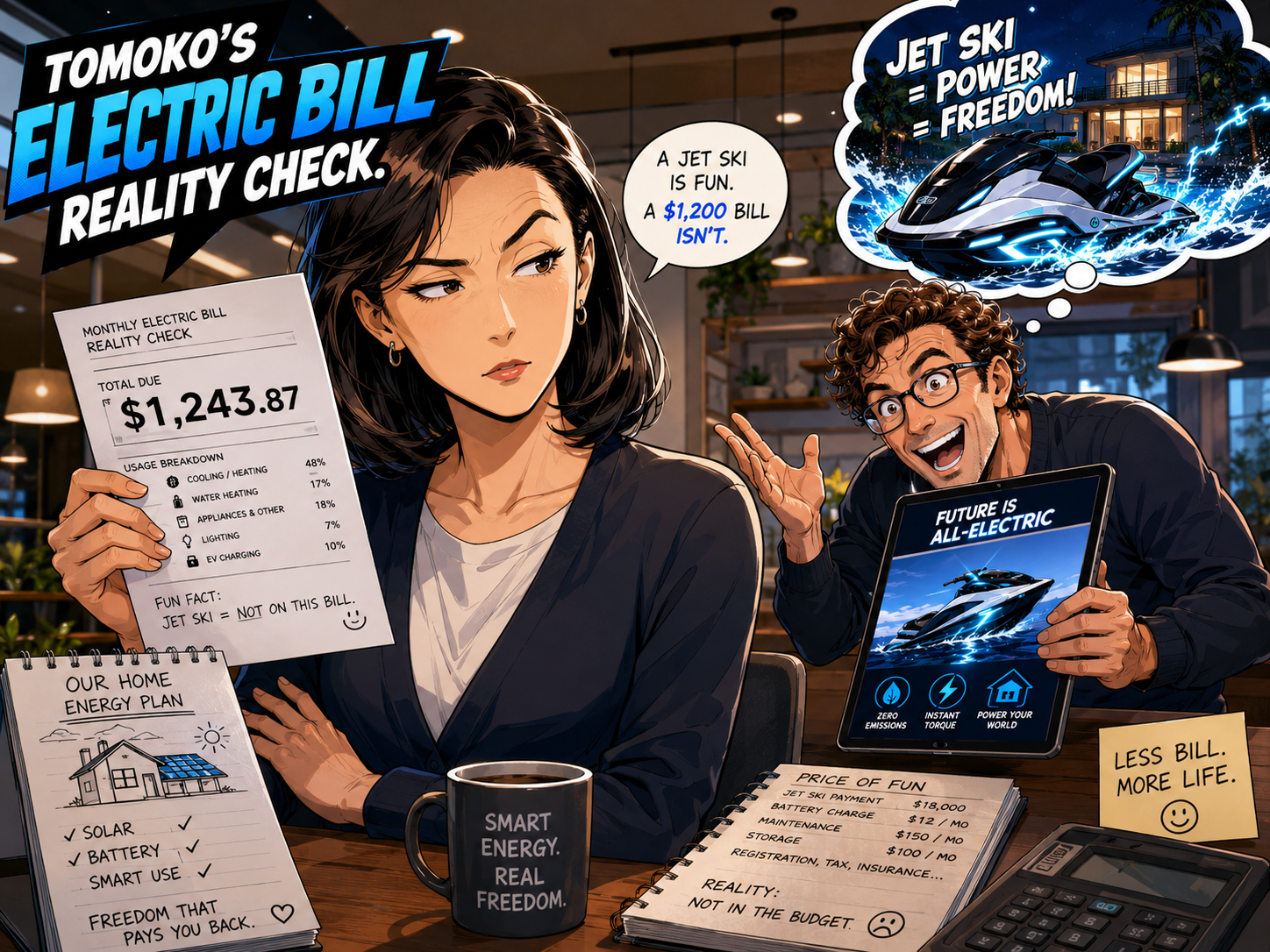
Tomoko reality check
Brad says the electric Jet Ski is a floating battery. Tomoko says the electric bill is already floating away with the budget.
“A Jet Ski is fun.” “A $1,200 bill isn’t.”
The reality check
Brad enters the room with the glow of a man who has found the future. Tomoko is holding the electric bill, which gives her the expression of a woman who has already read the future and found a service charge.
The electric Jet Ski may be beautiful. It may be clean. It may even become part of a serious battery-power story. But Tomoko sees the first truth: if the home energy plan begins with buying another expensive thing, the plan needs more work.
Why Tomoko wins the scene
Brad sees a Jet Ski powering the future. Tomoko sees payment, charging cost, maintenance, storage, insurance, safety, and the current electric bill still sitting on the table.
The monthly electric bill is not solved by pretending a Jet Ski purchase is a savings program.
A new electric toy still has purchase cost, charging cost, storage, maintenance, and insurance.
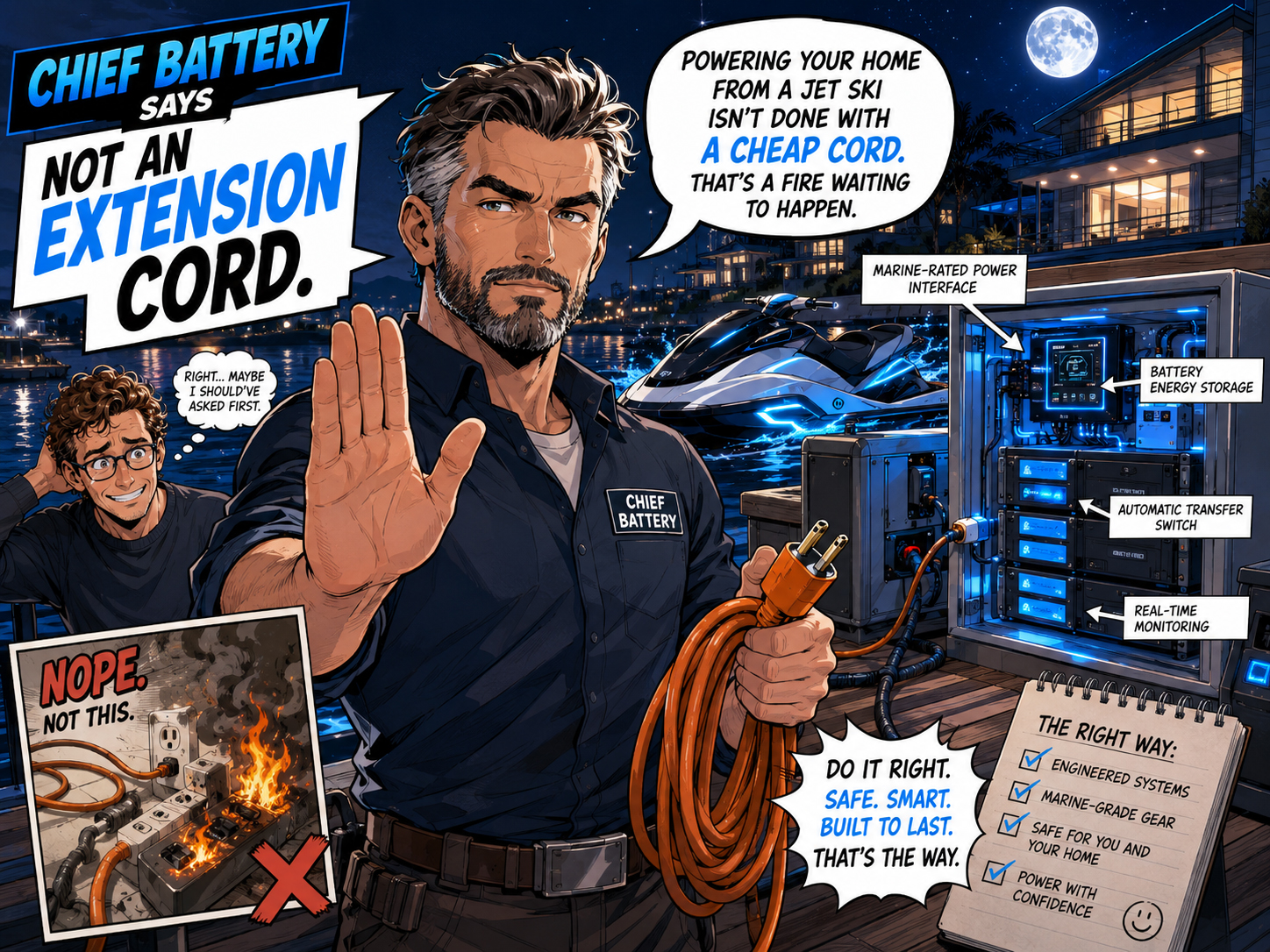
Floating battery power near water and homes requires engineered equipment, not improvisation.
Backup power starts with selected critical loads, not “the whole house because Brad is excited.”
Brad’s defense
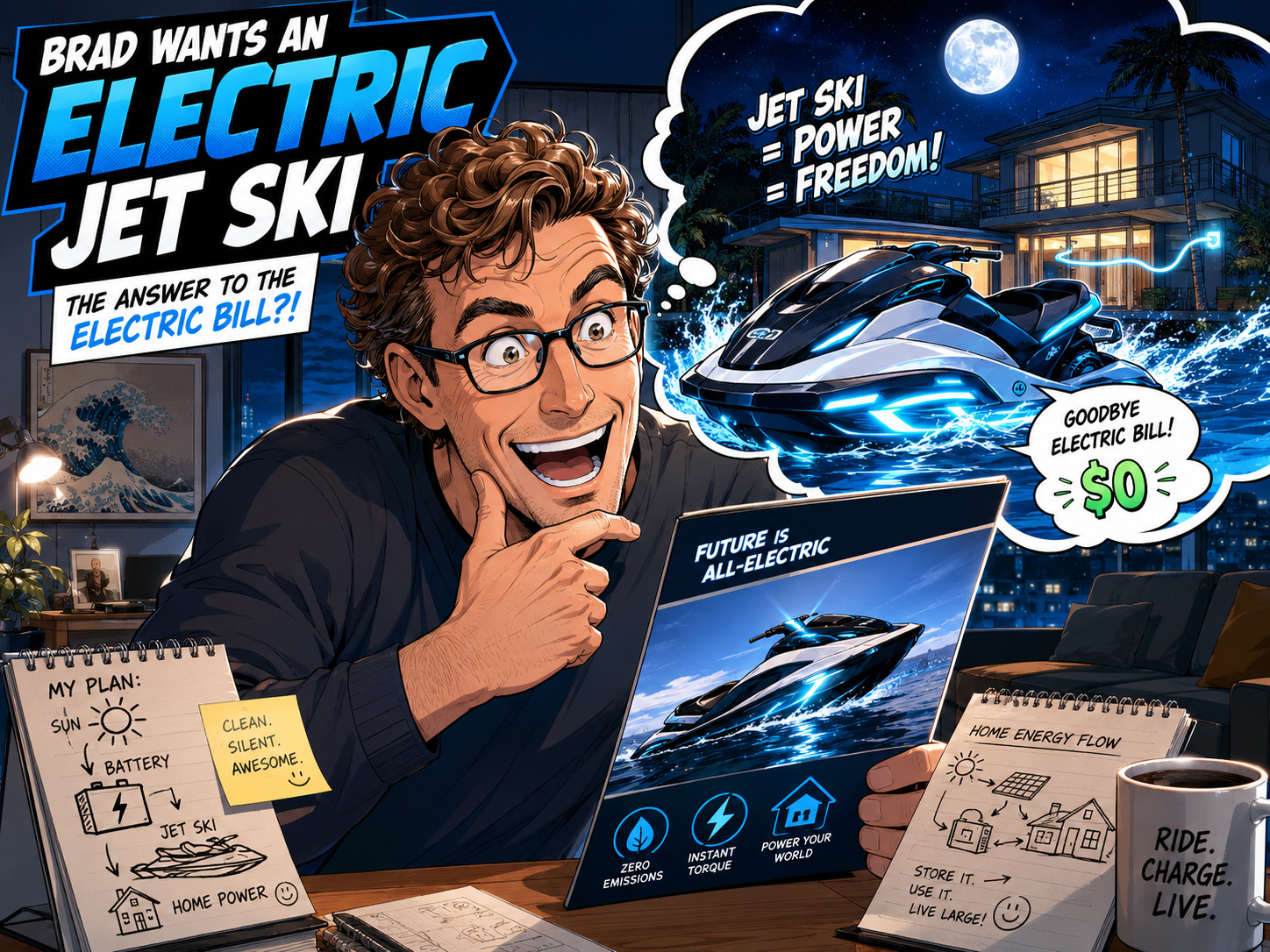
Brad’s pitch is not subtle. He says the Jet Ski can charge from solar, store energy, power critical loads, reduce bills, help the house, save the marina, and probably improve morale.
Tomoko listens long enough to identify the real problem: Brad is describing six different systems and one recreational vehicle as if they came in one box.
The episode in panels
The scene should be quick, funny, and painfully familiar.
“Tomoko, I found the answer to our electric bill!”
“Is it using less electricity?”
“Better. A Jet Ski.”
The electric bill becomes the loudest object in the room.
“You want to buy a Jet Ski because the electric bill is too high?”
“Technically, it is a floating battery.” Tomoko reaches for the calculator.
Chief Battery agrees with Tomoko
Chief Battery hears Brad’s idea and immediately removes the cheap cord from the conversation. If a Jet Ski battery ever supports a home or marina load, it must be done through engineered equipment.
Tomoko’s financial reality check and Chief Battery’s safety reality check point in the same direction: no shortcuts. No fake savings. No wet-dock experiments.
Tomoko’s corrected plan
The Jet Ski idea is allowed back into the room only after it becomes a real energy plan.
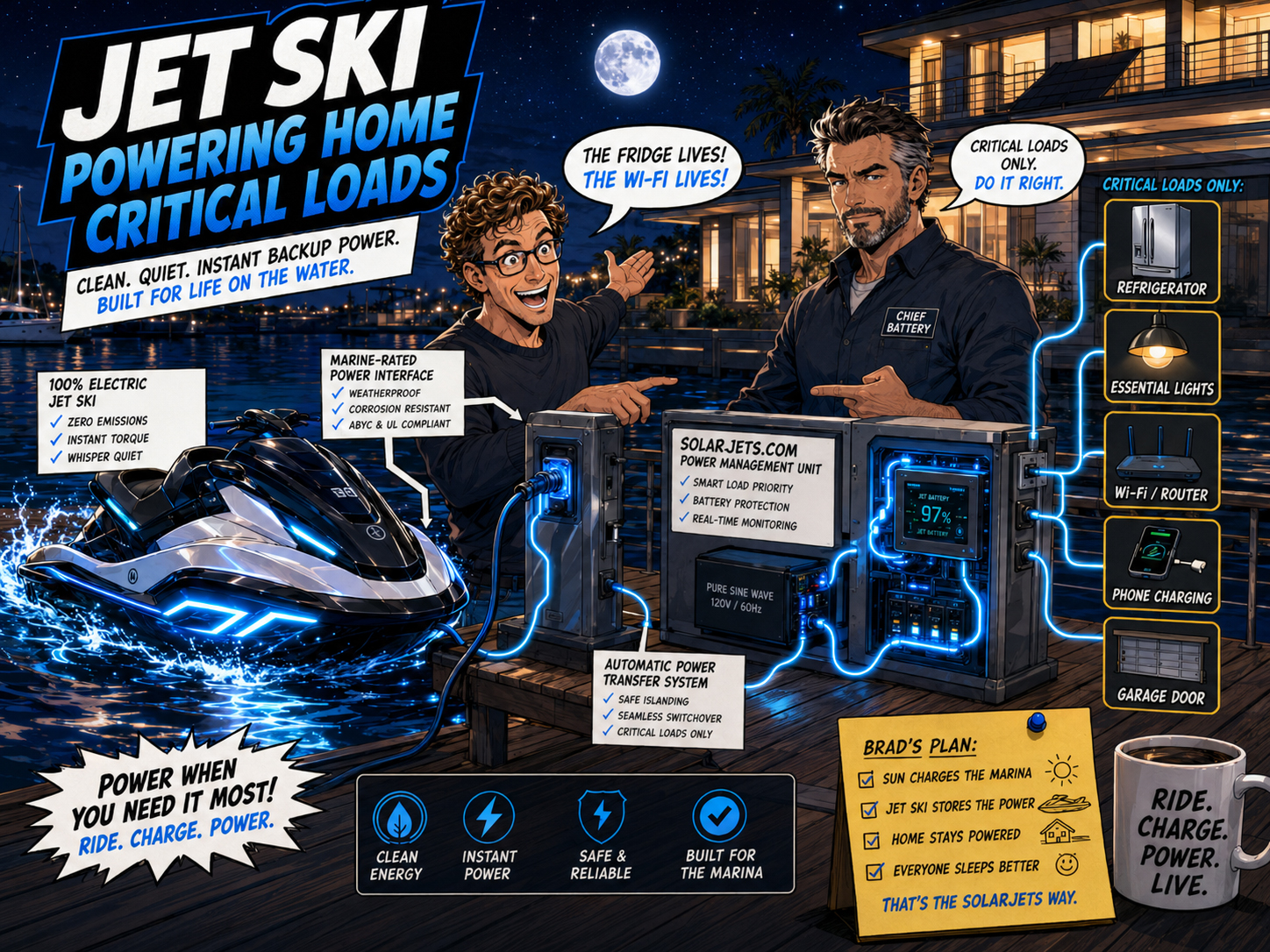
Refrigerator, essential lights, Wi-Fi, phone charging, and selected loads — not the whole mansion.
Open critical loads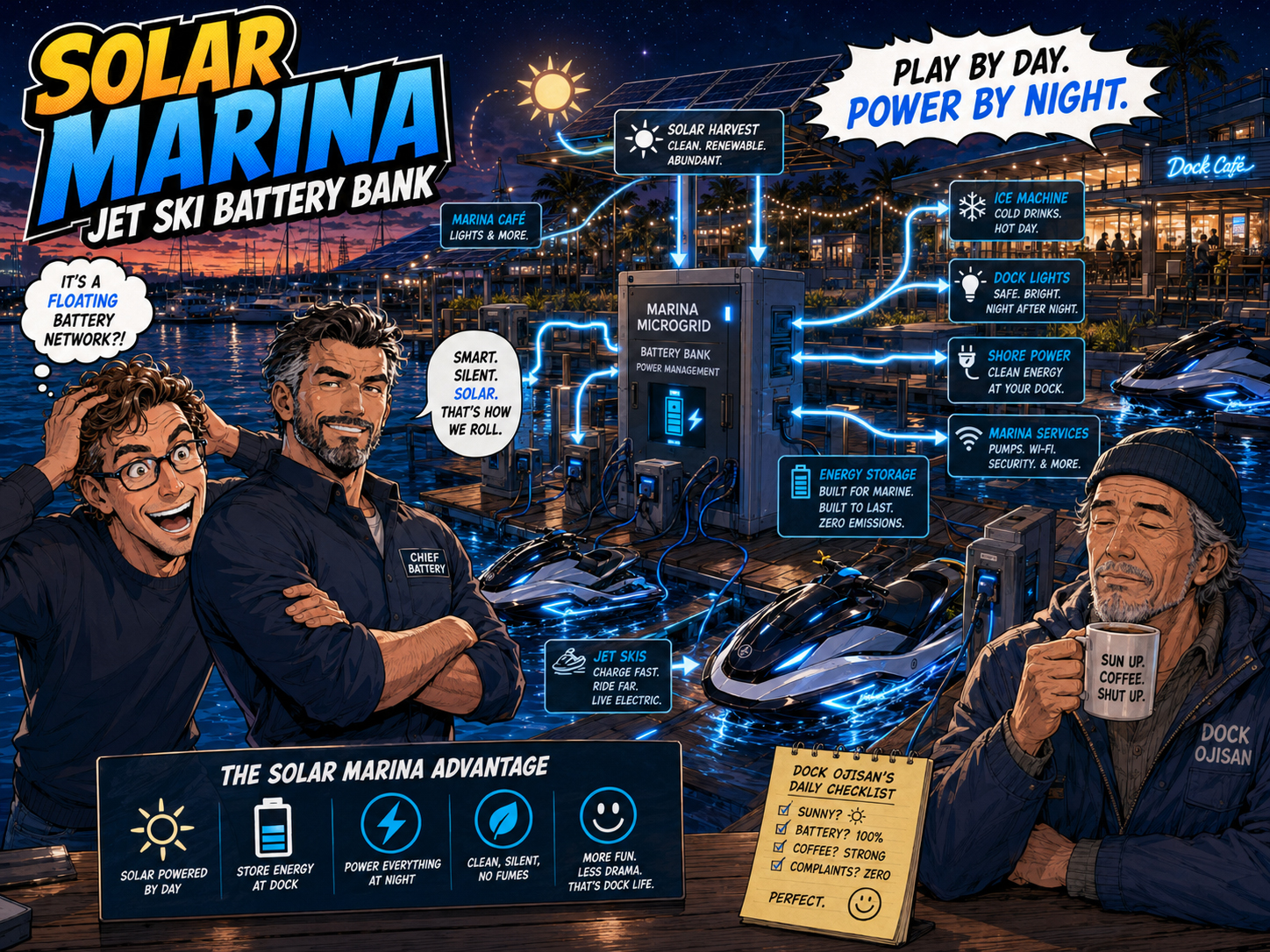
A bigger, more sensible version: marina solar, storage, dock power, and managed loads.
Open marina page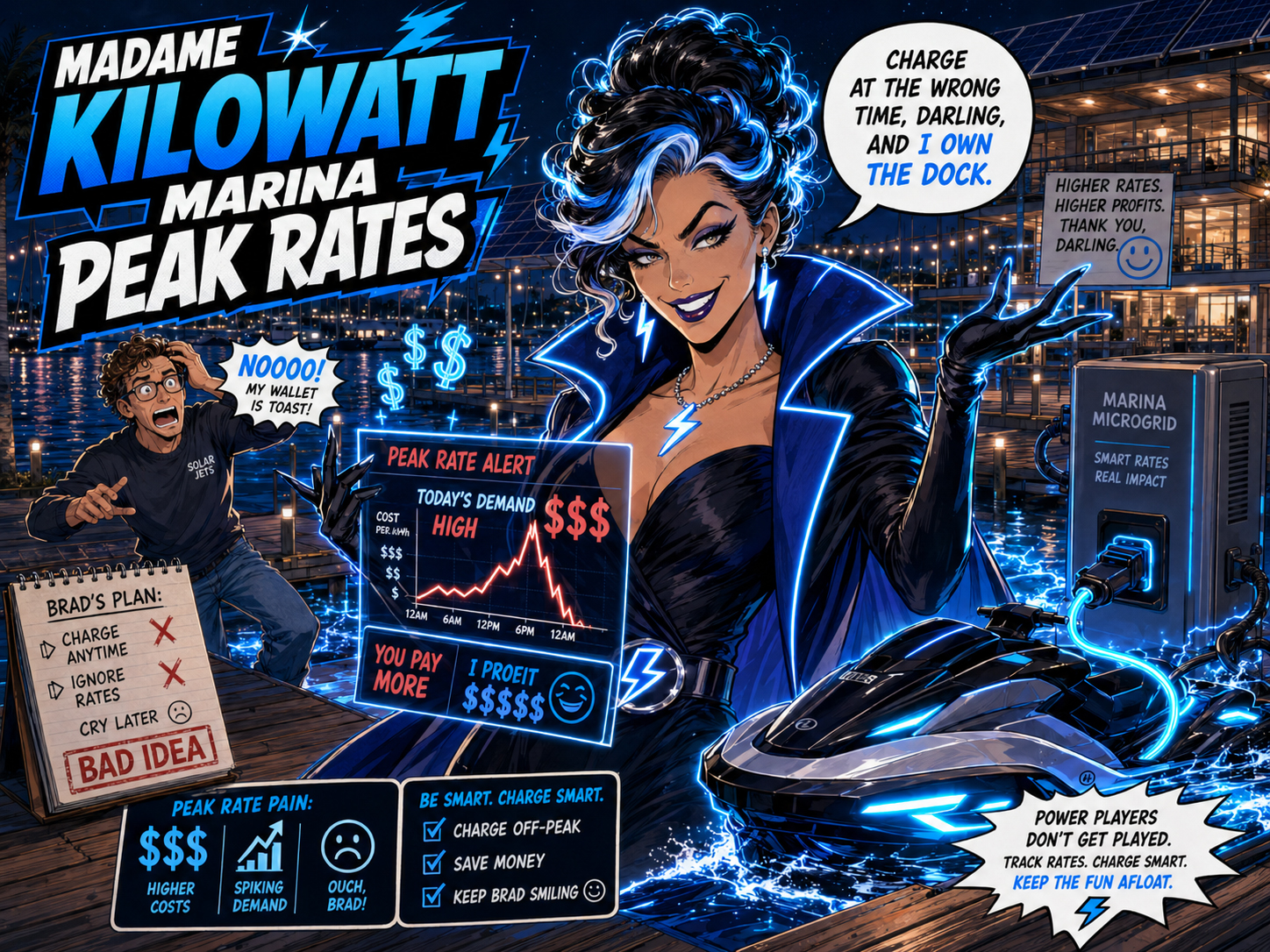
Charge at the wrong time and the bill becomes the villain again.
Meet Madame Kilowatt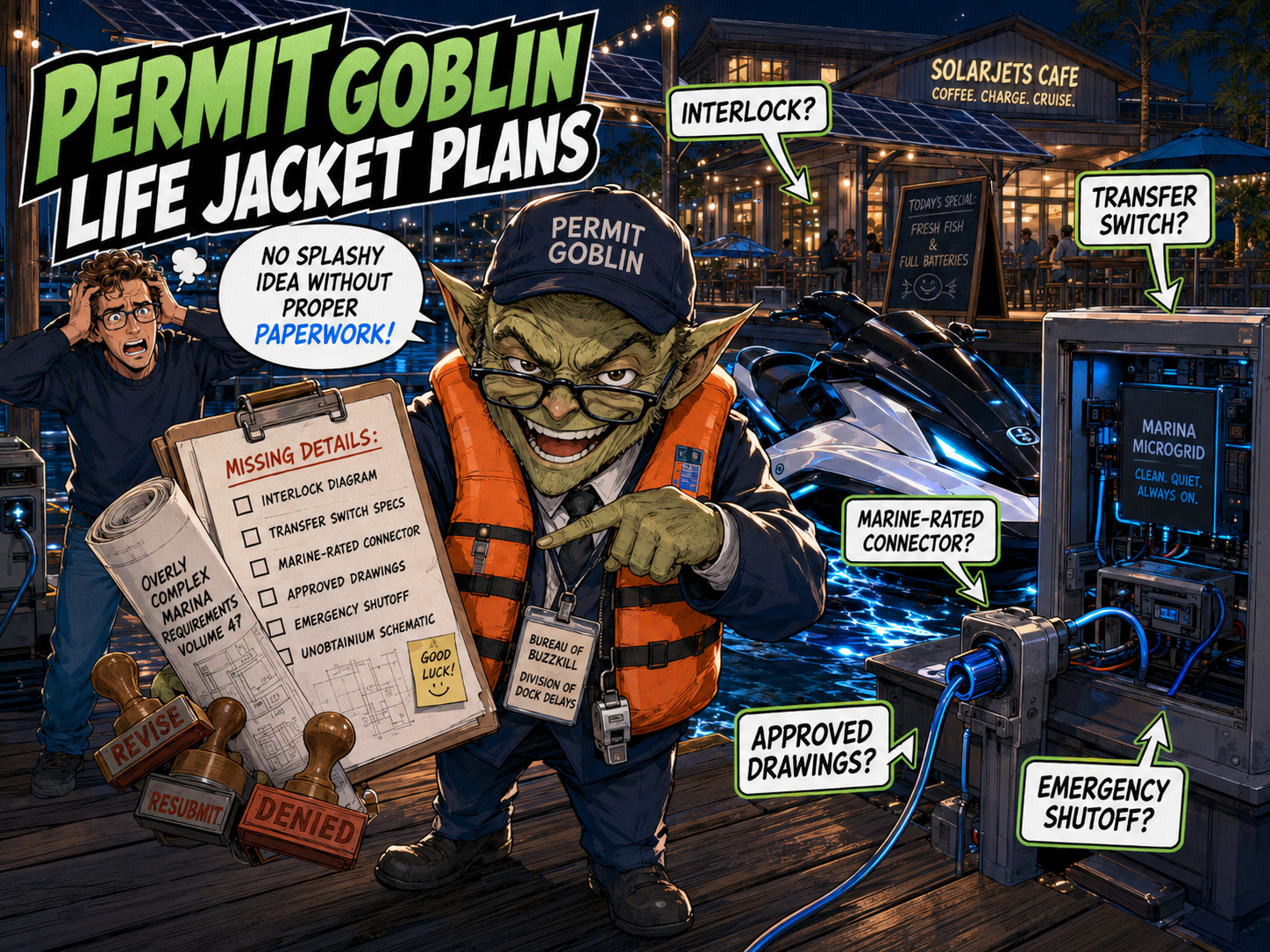
The paperwork creature joins Tomoko
Just when Brad thinks he has survived the electric bill, the Permit Goblin climbs out of the dock box wearing a life jacket and carrying a clipboard.
The goblin asks the annoying but necessary questions: interlock? transfer switch? marine-rated connector? approved drawings? emergency shutoff? Tomoko nods. Brad looks for a smaller brochure.
Tomoko’s three-part test
Not in theory. In the actual bill, with actual charging times, actual equipment cost, and actual use.
Water, batteries, homes, and power transfer require professional equipment and real engineering.
Critical loads, marina support, solar charging, or backup operation must be clearly defined.
Dock Ojisan’s verdict
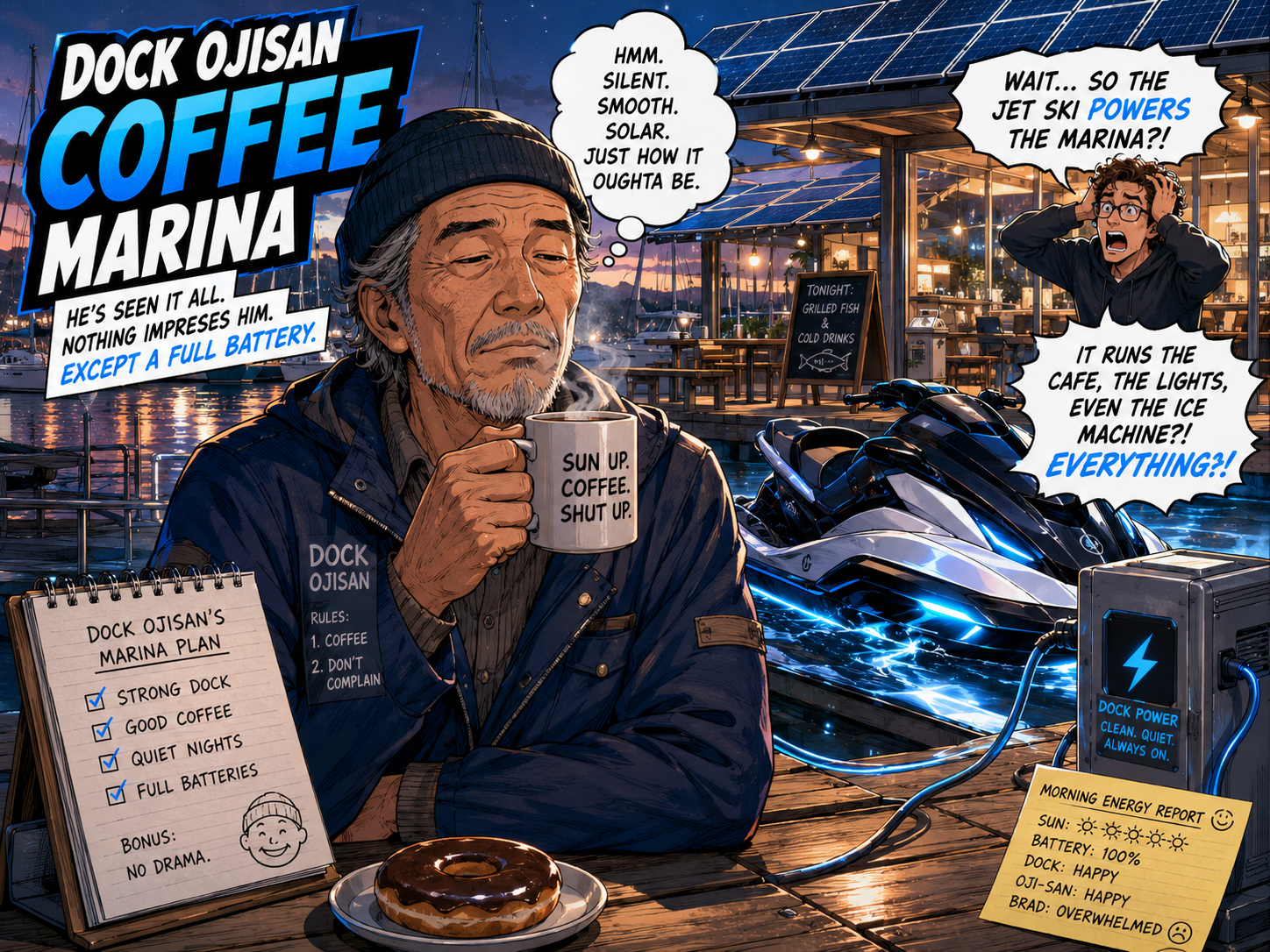
Dock Ojisan watches the whole argument from the marina café with coffee in hand. He does not care whether Brad wins the Jet Ski debate. He cares whether the dock is quiet, the batteries are full, the system is safe, and nobody is yelling at a smoking cord.
That makes him Tomoko’s silent ally. The best energy system is the one that works without drama.
Final reality check
The Jet Ski joke survives because Tomoko forces it to become an actual plan.
“Jet Ski equals power equals freedom equals goodbye electric bill.”
“Budget, safety, critical loads, rate timing, and proper equipment first.”
“Play by day. Power by night. Engineer it properly.”